
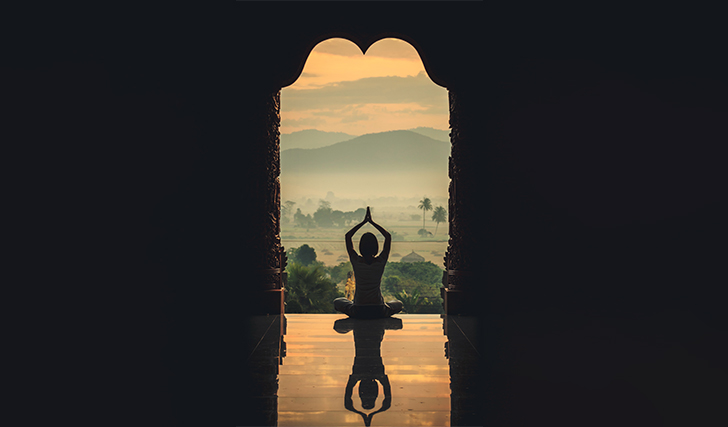
The body rarely asks for dramatic intervention first. More often, it asks for rhythm.
Regular sleep. Unforced breathing. Comfortable digestion. Steady movement. A mind that is not constantly anticipating the next demand.
Yoga therapy works in precisely this territory.
The word yoga is sometimes reduced to flexibility, posture or physical fitness. Therapeutic yoga is considerably more precise. A posture is selected because of what it asks from the breath, the nervous system, the joints, the circulation and the attention of the individual practising it. The same posture may be useful for one person, modified for another and left out entirely for someone else.
That individualisation matters.
Someone who spends ten hours a day at a desk may arrive with neck stiffness, shallow upper-chest breathing and a sense that the body has become permanently tense. Another person may move adequately but sleep poorly, wake unrefreshed and carry mental activity into the night. A third may feel physically well yet notice that concentration has become fragmented.
The therapeutic approach is not to force all three through the same sequence.
Carefully chosen movement can restore confidence in areas of the body that have become guarded. Slow breathing can bring attention back from constant external stimulation. Repetition gives the nervous system something dependable.
What patients often describe afterwards is surprisingly simple: “I feel lighter.”
Not necessarily because anything dramatic has happened.
The shoulders have dropped.
The jaw is softer.
The breath has reached the abdomen again.
There is more room inside the body.
That shift is where much of the value of Yoga Therapy in Kerala becomes apparent. In a therapeutic setting, yoga is not performed for visual perfection. It is used to create conditions in which the body can function with greater ease and the mind can become quieter without being forced into silence.
Healing often begins there.
The Breath Is Not a Small Part of the Treatment
Breathing is automatic, but the way a person breathes is deeply influenced by how that person lives.
Watch someone rushing between calls, meals, traffic and responsibilities. The breath often becomes quicker and higher in the chest. The abdomen barely moves. Exhalation shortens. Even while sitting still, the body behaves as though it must remain ready.
A slow, comfortable exhalation changes the quality of that state.
This is why pranayama, when used therapeutically, deserves more respect than it usually receives. It is not a decorative practice added after the postures. For some individuals, breath work is the central part of the session.
Gentle diaphragmatic breathing may reduce unnecessary muscular effort around the neck and shoulders. Measured breathing creates a natural pause between stimulus and response. Alternate-nostril practices, when suitable, can become a useful method of settling attention. Bhramari, with its soft humming exhalation, is particularly valued by people who find complete silence difficult at first.
The detail matters more than the technique.
A breath practice that creates strain has missed its purpose.
Long breath retention simply because somebody has read that it is “advanced” is rarely helpful. Therapeutic breathing should feel progressively more natural, not increasingly heroic.
A person who begins with a comfortable four-second inhalation and six-second exhalation may gain more from ten quiet minutes of consistency than from attempting elaborate respiratory ratios.
That gentleness produces an interesting change. People begin noticing their breathing outside the yoga room.
During an argument.
Before a presentation.
While waiting for medical results.
Sitting in Kochi traffic.
Trying to fall asleep.
The practice has travelled with them.
This is where yoga therapy becomes less like an exercise appointment and more like a physiological habit. The breath becomes an accessible way of reminding the body that every moment does not require the same degree of vigilance.
Small adjustment. Significant effect.
Movement Becomes Medicine When It Is Specific
There is a widespread assumption that yoga becomes more effective as the posture becomes more difficult.
Therapeutic practice often proves the opposite.
A person with chronic stiffness may benefit more from six carefully controlled spinal movements than from an ambitious sequence of twenty postures. Someone recovering strength may need support from a chair, wall or bolster. A person with limited hip mobility may require a smaller movement repeated slowly enough for the muscles to stop resisting it.
Precision changes everything.
Consider a person with long hours of computer work. The obvious complaint may be shoulder tightness. Yet the pattern can involve limited thoracic movement, forward head position, weak awareness of the shoulder blades and shallow breathing. Stretching the neck alone gives temporary relief. Working with spinal extension, scapular control, chest opening and breathing addresses the pattern more intelligently.
The same principle applies through the body.
Gentle twists can restore comfortable rotational movement.
Supported forward bends can encourage quietness without demanding excessive flexibility.
Carefully selected standing postures can improve balance, lower-limb strength and awareness of weight distribution.
Supine movements allow the spine to move without carrying the full load of the body.
Restorative postures create something increasingly rare in modern life: supported stillness without a screen.
A good session does not leave the individual feeling defeated.
It leaves the body organised.
This is especially relevant to Yoga Therapy in Kerala, where people often seek yoga alongside established systems of wellness rather than as an isolated fitness routine. The best programmes respect the person’s age, occupation, physical capacity, daily schedule and existing treatment plan.
Twenty minutes practised consistently can be more valuable than an exhausting ninety-minute session followed by three days of avoidance.
The body responds well to regularity.
There is another practical detail. Movement teaches confidence.
When someone has spent months protecting a stiff back or avoiding a particular movement, the body begins to associate movement with caution. Gentle, successful repetition gradually replaces that expectation. A bend that once felt threatening becomes familiar. Standing becomes steadier. Walking feels more natural.
The person begins trusting the body again.
That psychological effect is inseparable from the physical one.
A Quieter Mind Changes the Experience of the Body
Mental tension does not remain conveniently inside the mind.
It appears in posture, appetite, sleep, muscular tone, breathing, concentration and the way ordinary discomfort is perceived.
This is where the division between physical yoga and mental yoga becomes artificial.
A person lying in Savasana may appear to be doing nothing. Yet the practice can be remarkably active internally. The muscles release gradually. Breathing becomes less deliberate. Attention moves away from unfinished tasks and back towards physical sensation.
For some people, that is the first uninterrupted period of the day.
Yoga Nidra can deepen this process. Guided awareness moves through the body while physical movement is minimal. The individual is not asked to solve a problem, analyse an emotion or achieve a particular state. Attention is simply given a steady direction.
That steadiness is valuable.
Meditation works in much the same manner when approached without unnecessary ambition. Ten minutes of observing the breath consistently is often more useful than chasing an hour of perfect mental emptiness.
The mind will wander.
Bring it back.
It wanders again.
Bring it back again.
There is no failure in that cycle. The returning itself is the practice.
Over time, people often notice a little more distance between an uncomfortable thought and the reaction that normally follows it. Irritation does not disappear, but it may not dominate the next hour. Worry can still arise without automatically becoming the atmosphere of the entire day.
A calmer mind also changes how the body is experienced.
An ordinary sensation is less likely to be magnified by tension. Sleep becomes easier when mental activity is not being carried continuously into bed. Eating may become slower. Breathing may remain steadier during demanding moments.
Seen this way, Yoga Therapy in Kerala fits naturally within a broader culture that has long understood health as an interaction between physical state, mental quality, routine and environment.
That interaction deserves attention.
Not mystification.
Yoga Works Best When Daily Life Supports the Practice
A beautifully designed yoga programme cannot compensate indefinitely for a day built entirely around exhaustion.
This is where the quieter details begin to matter.
When does the person wake?
How soon after waking do they look at a screen?
Are meals regular?
Is the evening meal light enough for comfortable sleep?
Does the person practise at the same time most days, or only when the schedule becomes convenient?
Is there enough recovery between demanding work and bedtime?
These questions may sound ordinary. They determine whether the therapeutic effect of yoga has somewhere to settle.
Morning practice suits some people because the mind is relatively uncluttered and the stomach is empty. Others do better in the early evening because the practice becomes a transition out of work. The ideal time is often less important than the time that can be protected consistently.
Food deserves the same practical attention. An Ayurvedic Diet Plan can complement yoga when it is designed around the person’s digestion, constitution, appetite, activity and local food habits rather than copied from a fashionable list of “healthy” foods.
Kerala offers an advantage here. Traditional diets already include rice, vegetables, pulses, coconut, seasonal fruits, spices and numerous preparations that can be adapted without turning everyday eating into a complicated therapeutic project.
Yoga should simplify life, not make wellness another source of pressure.
The same principle applies when yoga forms part of Ayurveda treatment in Kerala. Both approaches become more meaningful when the daily routine is coherent: adequate rest, suitable food, measured physical activity, breathing practices and periods of genuine mental quietness.
A person staying at an Ayurveda Hospital in Kerala may experience this integration more clearly because the environment itself supports routine. Meals arrive at regular times. Treatments are scheduled. Rest is protected. Yoga is not squeezed between meetings or performed while notifications arrive every thirty seconds.
That setting reveals something useful.
Environment is part of therapy.
A home cannot become a retreat centre, nor should it. It can still contain a few protected habits.
No phone during practice.
A clean, quiet space.
A predictable time.
Comfortable clothing.
Enough time afterwards to avoid rushing immediately into the next demand.
These are modest arrangements.
They make the practice sustainable.
The Deeper Value Is Integration
The strongest effect of yoga therapy is rarely visible in a photograph.
It appears when someone notices that climbing stairs feels easier.
When an older adult stands from a chair with more confidence.
When a person who previously woke with a rigid back begins the morning with a few comfortable movements rather than fear of movement.
When a busy professional recognises shallow breathing during a difficult conversation and instinctively slows the exhalation.
When sleep arrives without the usual hour of mental negotiation.
When the body feels inhabited again rather than merely carried through the day.
That is integration.
A well-designed Yoga Therapy in Kerala programme respects this gradual process. It does not need theatrical promises. Yoga has considerable value without exaggeration.
Posture influences breathing.
Breathing influences mental state.
Mental state influences muscular tension.
Movement influences confidence.
Routine influences all of them.
The relationships are circular rather than linear.
This is also why yoga therapy can continue changing long after the supervised session ends. The person learns to recognise the early signals that usually go unnoticed: shoulders rising during stress, breath becoming shallow, lower back stiffening after prolonged sitting, attention becoming scattered, meals being rushed.
Awareness gives an opportunity to respond earlier.
Perhaps three slow breaths.
Perhaps five minutes of spinal movement.
Perhaps a short walk.
Perhaps an evening restorative posture rather than another half-hour of scrolling.
Nothing dramatic.
Repeated often enough, these small decisions change the texture of a day.
There is a particular wisdom in that approach. Health is not experienced only in clinics, therapy rooms or organised programmes. It is experienced while waking, working, eating, walking, breathing, speaking and sleeping.
Yoga brings attention back to those ordinary moments.
The body becomes steadier without being pushed.
The mind becomes quieter without being suppressed.
Breathing becomes fuller without being forced.
Movement becomes more deliberate.
Rest becomes something the person actually knows how to enter.
And gradually, the individual stops treating body and mind as two separate problems requiring two separate solutions.
They begin functioning as they always have.
Together.